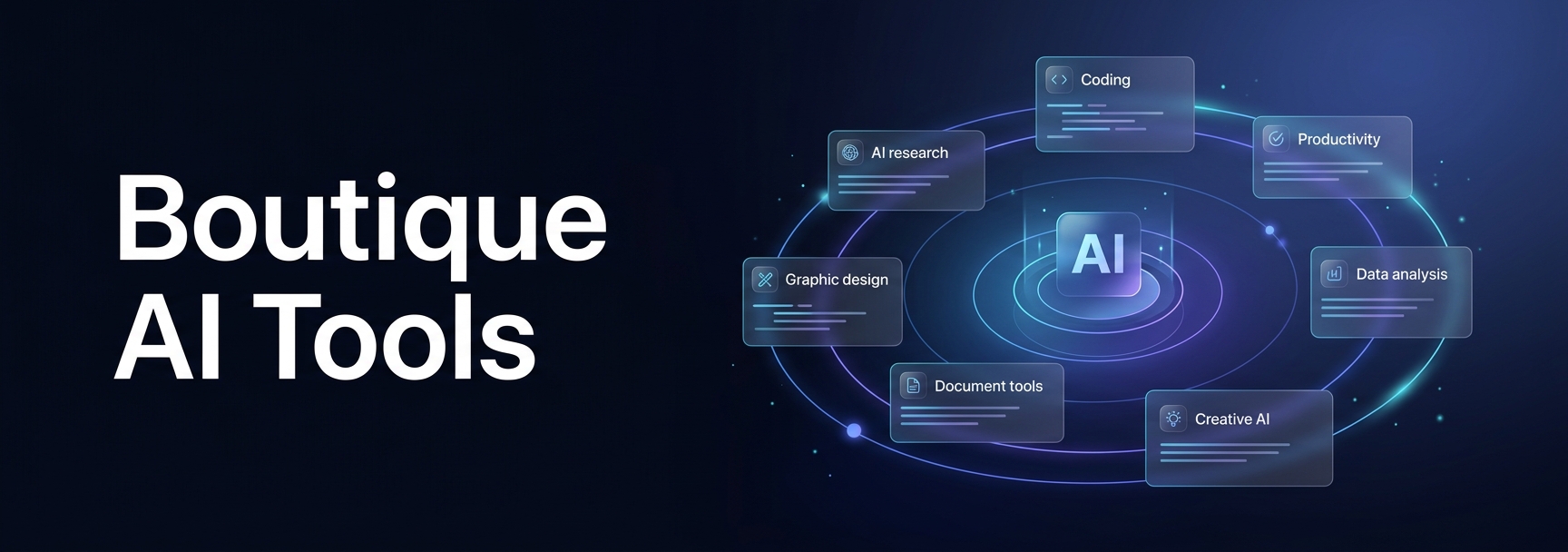
Boutique AI Tools: The Hidden Gems Big Tech Doesn't Talk About

When people talk about artificial intelligence, the same names usually appear: ChatGPT, Google Gemini, Microsoft Copilot, and Claude.
These platforms are powerful, accessible, and useful for a wide range of tasks. But they are not the entire AI ecosystem.
Beyond the biggest technology companies, thousands of smaller developers and independent teams are creating specialized AI tools designed to solve very specific problems. Some help researchers organize information. Others transform ideas into visual content, automate repetitive tasks, improve writing, or make complex workflows easier.
These tools are sometimes called boutique AI tools.
Unlike general-purpose AI assistants, boutique tools often focus on one particular task and try to do it exceptionally well. They may not have massive marketing budgets, but they can be surprisingly useful.
In this article, we explore what boutique AI tools are, why they matter, and the types of hidden AI solutions worth discovering.
What Are Boutique AI Tools?
Boutique AI tools are specialized artificial intelligence applications developed around a particular audience, workflow, or problem.
Instead of trying to become an assistant for everyone, a boutique AI product might focus on:
- Creating presentations from simple ideas.
- Turning rough sketches into polished designs.
- Summarizing lengthy research documents.
- Improving business writing.
- Organizing meeting notes.
- Generating product descriptions.
- Converting files into useful formats.
- Automating repetitive online tasks.
The term “boutique” does not necessarily mean that a tool is expensive or exclusive. It describes a more focused approach to product development.
A small AI company may understand the needs of a particular group better than a large platform serving millions of users with different goals.
For example, a general AI chatbot can help write a product description. A specialized e-commerce AI tool might go further by generating descriptions in a store's preferred format, organizing product attributes, and preparing content for a particular marketplace.
The difference is often specialization rather than raw intelligence.
Why Look Beyond the Biggest AI Platforms?
Large AI platforms are excellent starting points, but specialized tools can offer several advantages.
1. They Solve Specific Problems
A general chatbot may require several prompts to complete a complicated task.
A specialized application might provide a dedicated interface, templates, and automated steps for the same workflow.
For example, someone creating a presentation may prefer a tool designed specifically for presentations instead of asking a chatbot to generate every slide manually.
2. They Can Be Easier to Use
Not everyone wants to write detailed prompts.
Many boutique AI tools are built around simple actions:
- Upload a document.
- Choose a style.
- Select a format.
- Click Generate.
- Export the result.
This approach can make AI more approachable for beginners.
3. They Often Target Underserved Users
Large companies tend to prioritize products with broad appeal.
Smaller AI developers may focus on groups such as:
- Freelance designers.
- Teachers.
- Independent writers.
- Small business owners.
- Researchers.
- Developers.
- Online sellers.
- Content creators.
These users may discover solutions that are not widely discussed on mainstream technology websites.
4. They Encourage More Competition
A healthy AI ecosystem includes both large platforms and smaller innovators.
Boutique AI companies experiment with new interfaces, specialized workflows, and different business models. Some eventually become major products, while others remain useful niche solutions.
For users, this means there are always new tools to explore.
15 Types of Hidden AI Tools Worth Discovering
The following categories represent areas where specialized AI products can be particularly useful. The best option depends on your specific needs, budget, and workflow.
1. AI Research and Knowledge Management Tools
Research can involve reading articles, comparing documents, collecting notes, and organizing information.
General AI assistants can help with some of these tasks, but specialized research tools often focus on connecting information and making it easier to revisit later.
Useful features may include:
- Document-based question answering.
- Automatic summaries.
- Source organization.
- Knowledge graphs.
- Research note management.
- Information extraction.
Who can benefit?
Students, researchers, journalists, marketers, and anyone who regularly works with large amounts of information.
What to look for
A useful research tool should make it clear where its answers come from. Source references, document search, and transparent citations are especially important when accuracy matters.
2. AI Presentation Makers
Creating a professional presentation can take hours.
You need to organize ideas, write text, choose layouts, find images, and maintain visual consistency.
AI presentation tools can help turn a short description or document into a structured presentation.
Common features include:
- Automatic slide creation.
- AI-generated layouts.
- Presentation themes.
- Visual suggestions.
- Text rewriting.
- Export to presentation formats.
A practical example
Instead of starting with a blank presentation, you could enter:
Create a 10-slide presentation explaining how small businesses can use AI to improve productivity.
The tool may generate an initial structure that you can edit and personalize.
AI-generated slides should always be reviewed. A presentation that looks attractive may still contain weak information or an unclear structure.
3. AI Design and Visual Creation Tools
Graphic design is another area where specialized AI applications are becoming increasingly useful.
Some tools focus on creating images, while others concentrate on logos, illustrations, layouts, product visuals, or brand assets.
Potential uses include:
- Social media graphics.
- Product mockups.
- Marketing banners.
- Illustrations.
- Background removal.
- Brand concepts.
- Visual variations.
Why specialized design tools matter
A general AI image generator may produce an attractive image, but a design-focused tool may provide more practical controls for editing, layout, and production.
For businesses, features such as consistent branding, editable elements, and export options can be just as important as image quality.
4. AI Writing Assistants for Specific Industries
AI writing tools are not limited to blog posts and emails.
Some are designed for particular writing environments, including:
- E-commerce.
- Advertising.
- Technical documentation.
- Academic research.
- Legal document workflows.
- Customer support.
- Social media marketing.
A specialized writing assistant may include industry-specific templates and terminology.
For example, an e-commerce writing tool might help create:
- Product titles.
- Product descriptions.
- Frequently asked questions.
- Advertising copy.
- Category descriptions.
Important consideration
AI-generated content should be checked for accuracy, originality, and appropriate tone. Specialized does not automatically mean better for every project.
5. AI Tools for Meeting Notes
Meetings often produce valuable information that is difficult to organize afterward.
AI meeting assistants can help convert conversations into structured notes.
Depending on the product, features may include:
- Transcription.
- Meeting summaries.
- Action-item extraction.
- Speaker identification.
- Searchable meeting history.
- Follow-up task suggestions.
Who benefits most?
Remote teams, consultants, project managers, and freelancers who attend frequent meetings.
Before recording a meeting, make sure that participants understand and agree to the recording where required by applicable laws and workplace policies.
6. AI Tools for Developers
Developers have access to many general AI coding assistants, but smaller tools can focus on particular programming tasks.
Examples of specialized functions include:
- Explaining unfamiliar code.
- Generating regular expressions.
- Converting code between languages.
- Finding potential bugs.
- Creating test cases.
- Understanding API documentation.
- Generating database queries.
- Debugging configuration files.
Why specialization helps
A tool designed for one task can provide a more focused interface than a general chatbot.
For example, a regular expression assistant may allow users to enter a pattern, test it against sample text, and understand the results without writing a long prompt.
Developers should still review AI-generated code, especially when it involves security, authentication, payments, or sensitive data.
7. AI Audio and Voice Tools
AI audio applications are expanding beyond simple text-to-speech.
Specialized tools can support:
- Voice generation.
- Audio cleanup.
- Background-noise reduction.
- Podcast editing.
- Transcription.
- Voiceovers.
- Audio enhancement.
- Music experimentation.
These tools can be useful for content creators, educators, video producers, and small businesses.
What makes a good audio tool?
Look for:
- Natural-sounding output.
- Clear licensing terms.
- Export options.
- Useful editing controls.
- Transparent information about voice usage.
If a tool can imitate a recognizable person's voice, check that the necessary permissions exist before using the result commercially.
8. AI Tools for Video Creation
Video production traditionally requires multiple steps: scripting, recording, editing, adding captions, and preparing different formats.
Specialized AI video tools can simplify some of these tasks.
Possible features include:
- Text-to-video generation.
- Automatic subtitles.
- Video resizing.
- Script creation.
- Background removal.
- AI avatars.
- Short-form video editing.
- Scene generation.
A useful workflow
A creator might use:
- An AI writing tool to develop a script.
- An AI voice tool to produce narration.
- A video editor to assemble the scenes.
- An automatic captioning tool to prepare the final video.
Using several specialized tools can sometimes be more flexible than relying on one platform for everything.
9. AI Tools for PDF and Document Workflows
PDF files remain common in education, business, administration, and everyday work.
Many users need to perform repetitive tasks such as:
- Summarizing documents.
- Extracting text.
- Converting files.
- Compressing PDFs.
- Combining documents.
- Removing pages.
- Extracting tables.
- Asking questions about a document.
Specialized AI document tools can help users work with large files more efficiently.
A practical example
Imagine receiving a 70-page report and needing to identify:
- The main conclusions.
- Important dates.
- Financial figures.
- Recommended actions.
A document-focused AI tool may help locate this information faster than reading the entire document manually.
However, important business, legal, or financial documents should be reviewed carefully. AI systems can misunderstand tables, numbers, and complex formatting.
10. AI Tools for SEO and Content Research
Search engine optimization involves much more than generating articles.
Content creators and website owners may need help with:
- Keyword organization.
- Search intent analysis.
- Content outlines.
- Internal linking ideas.
- Title generation.
- Content briefs.
- Schema markup.
- Competitor research.
- Readability improvements.
Specialized SEO tools can organize these tasks into a more structured workflow.
What to consider
A useful SEO tool should support human judgment rather than simply produce large quantities of text.
Look for features that help answer questions such as:
- What information is missing from an article?
- Does the content address the reader's actual problem?
- Are the suggested keywords relevant?
- Are the internal links useful?
- Is the content accurate and original?
Publishing more AI-generated pages does not automatically create a successful website.
11. AI Tools for E-Commerce Sellers
Running an online store involves many repetitive tasks.
Specialized AI tools can assist with:
- Product descriptions.
- Product photography concepts.
- Customer-service responses.
- Marketing emails.
- Product categorization.
- Review analysis.
- Inventory-related workflows.
- Advertising ideas.
Example
A small online seller could use AI to turn a basic product description into several versions:
- A short marketplace title.
- A detailed product description.
- A social media caption.
- An email promotion.
- A list of product benefits.
The seller should still verify product specifications and avoid making claims that cannot be supported.
12. AI Tools for Productivity and Automation
Some of the most useful AI tools are not designed to create content. They help users connect applications and automate repetitive actions.
Possible uses include:
- Organizing incoming information.
- Classifying documents.
- Extracting data from emails.
- Creating task lists.
- Generating reports.
- Connecting online services.
- Automating routine workflows.
Why this category matters
Saving a few minutes on a single task may not seem important.
But if a repetitive task takes 10 minutes and happens 20 times per week, automation could save several hours over time.
Before connecting an AI automation tool to important accounts, review its permissions and data-handling policies.
13. AI Tools for Education
Students and teachers have different needs from businesses and developers.
Education-focused AI applications may help with:
- Creating practice questions.
- Explaining difficult concepts.
- Generating flashcards.
- Building study plans.
- Summarizing lessons.
- Creating language exercises.
- Providing feedback on writing.
The right way to use educational AI
AI should support learning rather than replace it.
For example, a student could ask an AI tool to explain a mathematical concept, generate practice questions, and provide hints instead of immediately revealing every answer.
Teachers should also review generated educational content for accuracy and suitability.
14. AI Tools for Personal Organization
Not every useful AI tool is designed for professional users.
Some specialized applications focus on everyday organization, including:
- Planning daily tasks.
- Organizing personal notes.
- Managing recipes.
- Creating travel itineraries.
- Sorting personal information.
- Building routines.
- Tracking projects.
The value of these tools often comes from reducing friction.
A simple application that helps someone organize information consistently may be more useful than a powerful platform with a complicated interface.
15. AI Tools for Accessibility
Accessibility is an important area for AI innovation.
Specialized tools may help users:
- Convert speech into text.
- Read text aloud.
- Generate image descriptions.
- Improve audio clarity.
- Translate content.
- Simplify complex language.
- Navigate digital information.
These tools can support people with different communication, reading, hearing, or visual needs.
Accessibility tools should be evaluated based on their actual performance in the situations where they will be used.
How to Discover Hidden AI Tools
Finding useful AI products is not only about searching for “best AI tools.”
A more effective approach is to search for a specific problem.
1. Start With a Task
Instead of searching for:
Best AI tools
Try searching for:
AI tool to extract tables from PDFs
Or:
AI tool to turn meeting recordings into action items
Specific searches are more likely to reveal products designed for your exact needs.
2. Explore AI Tool Directories
AI directories can help users discover applications by category.
You can explore tools for:
- Writing.
- Design.
- Video.
- Productivity.
- Research.
- Marketing.
- Development.
- Business automation.
Discover more AI tools and useful online utilities through ZUQREN.
A directory is a starting point, not a guarantee that every listed tool is reliable or suitable.
3. Read User Reviews Carefully
Reviews can reveal information that product websites do not emphasize.
Pay attention to comments about:
- Actual performance.
- Customer support.
- Pricing changes.
- Export limitations.
- Account restrictions.
- Data privacy.
- Reliability.
A tool with impressive marketing may not be the right choice for your workflow.
4. Test Before Paying
Whenever possible, use a free plan or trial before purchasing a subscription.
Test the tool using a real task that you regularly perform.
For example:
- Upload a typical document.
- Create a sample presentation.
- Process a real design project.
- Test the output against your normal requirements.
This helps you determine whether the tool provides practical value.
5. Check Privacy and Data Policies
AI tools may process documents, images, audio, code, or other sensitive information.
Before uploading private data, check:
- What information the tool collects.
- How uploaded files are stored.
- Whether data is used for training.
- How long information is retained.
- Whether files can be deleted.
- Whether third parties receive the data.
Avoid uploading confidential information unless you understand the risks and have appropriate authorization.
What Makes a Boutique AI Tool Worth Using?
A small AI product does not need millions of users to be useful.
However, it should provide a clear benefit.
Here are several factors to evaluate.
1. Does It Solve a Real Problem?
A tool should help you complete a task more easily, faster, or more accurately.
2. Is the Output Reliable?
AI-generated results can contain errors. The tool should provide a way to review, edit, or verify its output.
3. Is the Interface Simple?
A specialized product should ideally make its main function easy to understand.
4. Is the Pricing Transparent?
Check whether the tool uses:
- Monthly subscriptions.
- Usage credits.
- Pay-per-task pricing.
- Free limits.
- Additional charges for exports.
5. Does It Respect Your Data?
Privacy policies and security practices matter, especially when handling business or personal information.
6. Can You Export Your Work?
A tool may become difficult to use if your work is locked inside its platform.
Look for useful export formats and reasonable access to your own files.
Are Boutique AI Tools Better Than ChatGPT or Gemini?
There is no universal answer.
General-purpose AI platforms and specialized AI tools serve different purposes.
A general AI assistant may be useful when you want to:
- Ask questions.
- Brainstorm ideas.
- Write or rewrite content.
- Analyze information.
- Explore different topics.
- Work across several tasks.
A boutique AI tool may be more convenient when you want to:
- Complete one specific workflow.
- Use a dedicated interface.
- Follow a specialized process.
- Generate a particular file format.
- Connect a task to another application.
In many cases, the most effective approach is to use both.
For example, a general AI assistant could help develop an article outline, while a specialized design tool creates the accompanying visuals.
The best choice depends on the task, not simply on the popularity of the product.
The Future of Boutique AI Tools
As AI technology becomes more accessible, the number of specialized applications is likely to continue growing.
Developers no longer need to build every AI component from scratch. They can combine existing models with focused interfaces, industry knowledge, and useful workflows.
This creates opportunities for products designed around specific needs.
We may see more AI tools for:
- Local businesses.
- Specialized professional industries.
- Independent creators.
- Education.
- Accessibility.
- Personal productivity.
- Niche e-commerce markets.
- Technical workflows.
Some of these products may become major platforms. Others may remain small but valuable solutions for particular groups of users.
The important change is that AI discovery is becoming less about finding one tool that does everything and more about building a collection of tools that work well together.
Final Thoughts
The AI industry is much larger than the most recognizable technology brands.
Behind the major platforms, smaller developers are creating focused products that help users solve practical problems in writing, research, design, productivity, education, development, and business.
These boutique AI tools may not always receive widespread attention, but they can offer useful alternatives to familiar solutions.
The next time you need help with a specific task, do not search only for the biggest AI assistant.
Search for the tool designed specifically for the problem you are trying to solve.
You might discover a small AI product that saves time, improves your workflow, and becomes one of your favorite digital tools.
Explore More AI Tools With ZUQREN
Looking for more useful AI applications and online utilities?
Visit ZUQREN to explore AI tools, productivity resources, PDF utilities, image tools, and other digital solutions designed to make everyday tasks easier.